

Author Archives: Lydia Floren

NOMB Part II: Curbing The Impulse To Fix Others


NOMB curb others-recby Lydia Floren

NOMB (None Of My Business) Part II: Curbing The Impulse To Fix Others

When I see someone else’s struggle and “feel their pain”, I want so much to make it better. WHAT’s a person to DO? Here are a few tips:

#1 Face yourself:

  • Check your motives. Be honest with yourself about why you want to make it right. Your urge to fix is probably not as altruistic as it seems. Our motives are often mixed: sure we want to help, but we may also want to avoid the discomfort of watching others suffer or the annoyance of their “imperfection.”
  • Accept your limits in understanding and skill, and the specific ways God has asked you to serve in this world.

#2 Remind yourself of truth:

  • Pain is important. We are programmed to avoid pain at any cost, but experiencing pain is necessary; the stove’s heat or the wind’s cold prompt us to practical action. Leprosy is a malady where the nerves that detect pain are destroyed. Much of the disfigurement of leprosy comes because of the lack of feeling, not from the disease itself: a burn goes undetected, or an infection untreated, which leads to irrevocable tissue damage. Pain notifies us of danger or a need to change, even if that is just taking better care of ourselves.
  • Suffering is a part of life on earth. “In the world,” Jesus said, “you will have tribulation. But take courage: I have overcome the world.” He understands that we will have suffering—He experienced it himself many times. But he also knows that accepting hardship is not admitting defeat: far from it. God works all things out for the good of those who love Him and are called according to His purposes.
  • God uses all the pain in our lives, and sometimes He allows us to suffer for a reason. If He does so, He can be trusted: He has a good purpose in it, either for us or for someone else.
  • Your fixing can actually do more harm than good. What you think is helpful for someone else can often be downright harmful; how could you possibly know?

#3 Pray:

  • Thank God that
    He is at work in this situation, and good will come of it.
    His love for you and your loved ones is much greater than your own.
    His ideas, His strategy, His perspective, His understanding are far beyond you’re own.
    He will let you know if He wants you to do something in this situation.
    He will give you the self-control to resist the urge to step in where you don’t belong, and        the courage to step forward when He leads you to act.
  • Talk to God about the specifics. He already knows what is going on, but also knows that you need the listening ear of a loved one to hear your concerns. (It really helps. Trust me.)
  • Ask God what He wants you to do or not do.
  • Listen for His answers.

#4 Act: There are many ways God MAY ask you to help. You might be led to do one or a combination of the following:

  • Intercede. Often when I see difficulties in another’s life, I feel like God’s primary request is for me is to pray for that person. This is not a last resort. It is actually the most powerful action I can take because prayers invite the power of God’s spirit into the situation. Perfect power and perfect love, working on the problem! Who doesn’t want that?
  • Encourage. The most important thing a person can do–outside of praying–for someone in difficulty is to encourage them. Encouragement can be as simple as a smile, a hug, a note, or a shared laugh. It is easy to encourage via phone, text, Facebook, or email. A moment of thoughtfulness can make a world of difference in someone’s day, especially when they are going through a hard time.
  • Listen. God gave us two ears and one mouth, right? Listening is a powerful encouragement. Giving someone a safe place to articulate a problem or vent emotion is actually therapeutic. I have seen this over and over in the practice of medicine.
  • Serve. Practical acts of service, such as a gift, a visit, a meal, an offer to babysit are “cups of cold water” given in Jesus’ name. They help lighten another’s load in the most literal sense.

“It’s God’s problem. He should worry”
To be honest, it is a relief to acknowledge my limits, and accept my inability to fix others. When I do, I find I worry less. I pray more. My focus centers on God’s sufficiency rather than specific problems. And I am more likely to pay attention when God leads me to how and when I should act, or if it is best for me just to concentrate on prayer.

At most I might be a small part of a solution to someone’s problem. I am certainly not meant to be The Solution. Only God can be that; when I try, I just get in the way.

Accepting my limits frees me to do what God has already asked me to do—what we are all called to do in this world: love people. This love may take the form of prayer, encouragement, listening, and/or serving.

It’s our job to love folks. It’s God’s job to fix them.

Recent Series: NOMB Part I: Letting God Be The Fixer; Patience

NOMB Part I: Letting God Be The Fixer

by Lydia Floren

NOMB (None Of My Business) Part I: Letting God Be The Fixer

Fixing Things

I am a fixer by nature and nurture. By nature, according to the Myers-Briggs personality test I am an Extroverted-Intuiter-Feeler-Perceiver, and ENFP’s like me enjoy solving problems. You could say that my tendency to want to fix things is hardwired in my DNA. By nurture, I grew up the middle child. As such, I was the de facto ambassador in parental negotiations and the swing vote in sibling disputes. My fix-it-ness was reinforced in medical school, where I learned to analyze and diagnose and advise and treat all sorts of ailments. You could say I had a “license to fix.”

But nothing has fine-tuned my fixing skills more than motherhood. As every parent knows, moms are required to fix all kinds of stuff like scrapes, scuffles, bad manners, and hurt feelings. Oh yeah, and spilled milk, throw-up, and crises in the carpool. And—lest we forget–moms are more often than not responsible for fixing dinner.

No wonder it is hard for me to turn off that fixing nature. (And why would I want to? I’m so good at it! But I must—MUST– resist the urge. Fixing other people’s lives is waaaaay out of my job description. It is one thing to help someone solve a problem when asked (such as in my role as physician), or when someone depends on you (as in mothering a small child). But most of the time people don’t need—or want–me to diagnose what is wrong with them and try to correct it. That is almost always the worst thing a person can do. Ask any teenager.

Folks, including teenagers, just want to be loved and accepted. They want to be enjoyed for who they are. They want someone to believe in them and pray for them. People want someone to listen while they talk out their dilemmas so they can come up with their own solutions.

SIGH.

OK, so how does one curb this fixing habit? Here’s a great start: Remind yourself every day that YOU ARE NOT GOD.

Note to self: I am not God.

I am not God. I know this shocks those of you who know me, but I just wanted to get it out there so you could get used to the idea.

Here are a few additional reminders that are helping me curb my fixing habit:

  • I don’t know the big picture. I do not have enough information to even judge what another person’s problems are, much less to solve them. I might see glimpses, but they are just that—flashes of insight. It takes much more information than this to make an accurate diagnosis and recommend a remedy. As we in medicine like to say, “A little bit of knowledge is a dangerous thing.”
  • I don’t have the skills. Another axiom in the practice of medicine is, “Know your limits.” Not only do I lack adequate information, I also lack the ability to “fix” someone else.
  • It is not my job. As much as I might act like it sometimes, God has not asked me to fix anyone. I don’t think He ever would, and it would be beyond me if He did.
    My “fixing” might hurt more than it helps.

What about you? Do you ever have the inclination to try to FIX THINGS?                                            If so, then repeat after me:

“I am not God. I am not God. I am not God.”

Oh, gracious! There I go again. Now I’m trying to fix YOU! Ugh!

note not God-rec

Recent Series: Learning to Fish, Our Problems Are Not The Problem, Four Practical Steps

Four Practical Steps to Overcoming Problems – Overcoming Series, Pt. III

by Lydia Floren

In the Overcoming blog series, we have been talking about—well—overcoming problems. In this process, it helps to:

  • Remember who Jesus is, and what God can do.
  • Accept the truth that problems are a part of life.
  • Jesus has overcome the world. He has conquered the ordered system of evil we live in.

But how do we apply this to our everyday lives?

4 practical steps

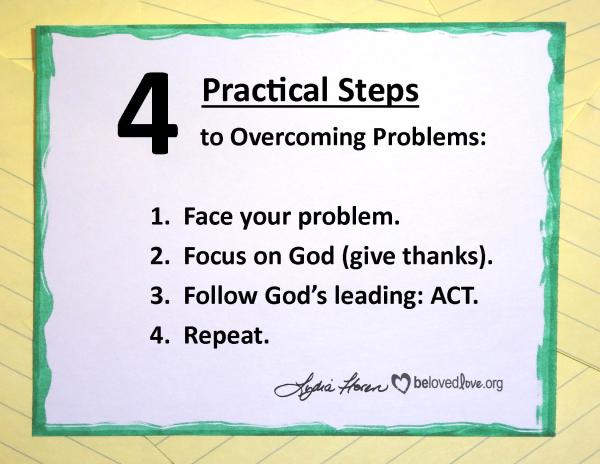
Four practical steps to overcoming problems:

1. Face your problem

  • Face the problem honestly. Don’t avoid it, blame someone else, or pretend it isn’t really a problem. In intense emotional reaction to a situation, especially if it seems out of proportion to the facts, may be a clue to you that you have an unidentified issue; examine it with courage.
  • Identify YOUR problem. Ask questions. For example, if you have a problem with a coworker, ask yourself, “What is happening? What is my reaction? What reasons might I be reacting this way? Am I making false assumptions? Generalizing? Why?” Asking questions helps you get to the real problem, which may be that this co-worker triggers something from your past and brings up old pain.
  • Don’t let problems become your identity; keep the problem the problem. For example, say “I experience anger in certain situations” not “I am an angry person.” And don’t generalize about someone else, as in, “They are a no-good-very-bad person because they make me angry.”
  • Be willing to change in your reaction to the problem. Problems are opportunities and avenues for change. Be flexible and teachable. Own your own emotions. Be willing to change.

2. Focus on God by giving thanks.
Giving thanks is a powerful way to return our attention to God, and put our problems in perspective. Give thanks for the following:

  • The situation, and that you are learning from it.
  • Who God is, and his faithfulness to you.
  • What God is showing you about the dilemma you are facing, and what His perspective might be.
  • What God offers you: strength, direction, His presence, and–most important–his promise to work everything to a good end.

3. Follow God’s Leading: ACT

  • ACT: Step forward in the direction you sense God is leading.
    If you really don’t know what to do, wait for clarity, if possible. If a decision is pressing, align your choice with previous ways He has led. Use your best judgment, after reviewing as much information as possible.
  • Sometimes you will misunderstand what He is telling you, and head off course. That’s OK. It happens a lot, actually. It is part of the process of learning to listen and follow. Think of it like this: it is much easier to steer a moving ship than one that is dead in the water. As you go, God will adjust your path and redirect you as needed.

4. Repeat

  • When you face difficulties, it is great to have a solid habit in place for dealing with challenges. Repetition creates habit. As you choose over and over to face, focus, and follow, you will build a pattern of strength and wisdom to address the next problem. Which, after all, is only two weeks away!

‘Do not fear, for I am with you; do not anxiously look about you, for I am your God. I will strengthen you, surely I will help you, surely I will uphold you with My righteous right hand.’ Isaiah 41:10 NASB

Share with us! What practical tips do you use to overcome problems in your life?

Related posts: Learning to Fish, Our Problems Are Not The Problem

Our Problems Are Not The Problem – Overcoming Series, Part II

by Lydia Floren

In the last blog Learning to Fish, I said:

“It is so easy to forget who Jesus is, and what God can do.  We have seen Him do amazing things yet when we face difficulties, we tend to focus on the problem instead of on The Solution.   When we fixate on the problem, we might get to work trying to find a solution on our own.  The busier we get “solving problems,” the harder it is to remember what—and Who—is important. “

In other words, our problems are not the problem.

As long as we are in this world, we will have problems. In fact, Jesus words are startlingly clear:

“In this world you will have trouble. But take heart! I have overcome the world.”

The problem is we forget these 2 key truths:  problems are a part of life on earth, and Jesus has overcome the world.

Problems are a part of life on earth.  “In this world you will have trouble.”

We all have problems.  But no one wants them.  We want a life of comfort, undisturbed by pain or distress.  So one reaction we might have to difficulties is to deny that they exist. If we aren’t careful, avoidance or denial can become our primary modus operandi, and it is driven by fear. We are afraid of future problems, or that a difficulty won’t be resolved to our satisfaction. We try to please everybody. We smooth things over.  We worry.  We think that burying our heads in the sand will just make problems go away.

In order to truly overcome, we must first accept that we will have problems throughout our lives.  No one escapes this reality.  According to one study, in a person’s life the average time span between one problem and the next it is 2 weeks.  2 weeks!  That means that, at best, we may have a 14 days reprieved after our last “issue” before we are faced with our next one. While that may sound depressing on the surface, it is really quite liberating, and here’s why:  when we know that difficulties will come, we are less surprised by them.  We can see them as part of the fabric of life, rather than a “detour” from the life we imagined.

eore

The Eeyores among us

Now there are some “Eeyores” among us.  Eeyore, the donkey from the Winnie the Pooh stories, was a cup-half-empty kind of guy.  He always found something to worry about.  Lest you become like—or more like– Eeyore, let me be clear:  Accepting that there will be difficulties on our journey does not mean we are to anticipate trouble around every bend.

When we expect the worst, we live in a pretty dismal reality, and so we tend to cope with this by either enduring or escaping.  Here’s what I mean:

Enduring. If we believe that life is no more than a long series of problems, we might decide that the best we can do is endure it.  We may develop a victim mentality or become poisoned with self-pity.

Escaping. An alternative to enduring is to try to escape life—to check out, via our favorite addiction (food, social media, TV, games, work, thrills, sex, porn, substance abuse, etc.) But the distraction doesn’t cure our hopelessness.

Choose to accept problems as a part of life, but don’t stop there—also embrace the truth that Christ has overcome.  The second half of Jesus’ statement is much more important than the first:

“In this world you will have trouble. But take heart! I have overcome the world.”

Jesus has overcome the world.

While it is important for us to accept troubles as a normal part of life, it is even more crucial to remember this:  Jesus has overcome the world.

What exactly does “overcome the world” mean?

In Greek, “overcome” means “to conquer, or prevail”, and the literal translation for “the world” is “an ordered system.”  Putting these together, Jesus said that He has conquered the ordered system we have been living in, a system riddled with evil and deception. His victory is far more profound than a political coup or a military conquest. His victory is over evil itself! His triumph spans generations and penetrates every willing soul.

So where does that leave us with our troubles?

  •  Even though we have troubles, those troubles won’t defeat us.
  • Even better, every difficulty we encounter can be used by God for our good.
  • Here is something truly amazing:  not only did Jesus overcome this system of evil, He gave each of His children this same power to overcome.   
  • We can have peace in Him. Even in the middle of difficult circumstances, God can give us a profound sense of inner peace, a stillness deep within ourselves that no circumstance can touch.

“I have told you these things so that in me you may have peace. In this world, you will have trouble. But take heart! I have overcome the world.”  John 16:33

Next week: 4 Practical Steps In Overcoming Problems


Related posts: Learning to Fish

Learning to Fish on the Right Side of the Boat – Overcoming Series: Part I

boatPainting by Alexei Birvukoff

by Lydia Floren

There is a great story in the Bible where Jesus was at the shore of a huge lake, looking out over the water. He was watching a boat approaching:  His disciple Peter was returning home from a fruitless night of fishing.  Peter must have been discouraged.  Who wouldn’t be after working their tail off and seeing no results? As he stowed away his gear, he glanced up and noticed someone standing on the beach: Jesus.

“Hey Peter, throw your nets out on the other side of the boat”.  Jesus hollered out to him.

That’s nuts, Peter thinks.  He just doesn’t understand. We’ve been at this for hours and hours.

“I’ve been fishing all night,” Peter hollered back, “we haven’t caught a thing.

Silence. I can just hear Peter talking to himself:

OK, Peter, that was kind of stupid. Jesus knows everything.  I’m sure He is aware that it’s not been a good night of fishing. Yet still…he said to put my nets back down, this time on the other side of the boat. Maybe he knows something I don’t know about where the fish are. I’ve seen him do some pretty amazing stuff.  Like the whole feeding the 5000 thing. [sigh] If Jesus says to do this, it is probably worth a shot to haul up the nets and throw them out one more time, wherever He says to throw them. 

  “OK guys let’s do this,” Peter ordered.  “Grab the nets, and cast them on the far side of the boat.” 

His crew might have just stood there, incredulous.  They were as bone-weary as Peter was, and were savvy enough fishermen to know when to pack it in.  Maybe they muttered a few choice comments to each other, waiting for Peter to come to his senses.

Peter didn’t care.  He knew Jesus.  They didn’t.

“Well, what are you waiting for?” He shouted. “Get moving.”

The sailors suddenly scrambled into action. They gathered the nets, and then cast them once more, this time in a most unpromising place. Or was it?  Their skepticism shifted to awe as their nets immediately started filling with a catch so huge that they started to break.

511046.TIF

Peter just shook his head, bemused.  He’d seen Jesus do this kind of thing before.  Yet even with all Peter’s experiences–after having witnessed miracle after miracle–it was still so easy for Peter to forget who Jesus was, and what God could do.

2000 years later, nothing has changed.

It is so easy for us to forget who Jesus is, and what God can do.

In our lives today, it is so easy to forget who Jesus is, and what God can do.  We have seen God do amazing things in our lives–and the lives of others–yet when we face difficulties, we tend to focus on the problem instead of keeping our eyes fixed on The Solution.   We worry about what we see, instead of looking beyond to what God is doing.  When we fixate on the problem, we might get to work trying to find a solution on our own.  The busier we get “solving problems,” the more distracted we can become, and it gets harder and harder to remember what—and Who—is important.

In overcoming problems in our lives, we must stay focus on God, and do our best to follow His lead.

                Next week:  our problems are not the problem.

How do you stay focused on God when you have problems?

it is so easy-fish-rec

Recent posts: Circling Back, Sharing a Sunset, Enjoying God’s Presence.

Savoring A Taste of Heaven. Joy Lives In Contentment.

by Lydia Floren

One Saturday last August, Andrew and I blasted ourselves out of our rut and spent the day boating on nearby Lake Wissota. It was a perfect Wisconsin summer day. The water, hemmed by lush green, shimmered in the quiet morning light. The sun was warm, not hot, and a gentle breeze was rustling the trees.

Picture1.1

Picture5

For the first half of the day, we puttered from one end of the lake to the other. I was preoccupied. My thoughts kept drifting away from this beauty to the restlessness of “I wants.” I want to live on the water. How could we find a way to do it? Where would be the best place to live? Wonder what the property values and taxes are? Is it feasible? Wonder how much that property costs? I was distracted by what I didn’t have, instead of focusing on what I had been given:

  • A gorgeous day.
  • The company of my wonderful husband.
  • A panorama of natural beauty.

About midway through the day, I pulled out my camera and started snapping pictures. My attention was captured by lily pads and weeping willows, craggy cliffs, wild flowers, and of course the water–rippling, reflecting, shimmering, and sparkling. An awareness of my surroundings remained long after I stowed my camera. I noticed the quiet sounds of crickets buzzing and water lapping. I felt the tangled senses of sun-warmth and cool breeze. I experienced the gentle rock of the boat lulling me to sleep. I was content.

Picture2

Picture3

Picture6

God offers me tastes of heaven every day–and every day I choose. Do I strain to look beyond the amazing gifts in front of me? Or, do I savor the blessings I have already been given?

Joy lives in contentment.

(BTW, I didn’t photograph a single house.)

Share with us: How do you remain content? We would love to hear from you.

Recent posts: Circling Back, Sharing a Sunset, Enjoying God’s Presence.

Circling Back

u turn arrow

Circling Back

by Lydia Floren

God loves me—personally, and intimately.

 I feel like God has taught me a lot over the years, but it all seems to circle back to the fact that He loves me.  Me, personally.  Not me as a part of the universal blob known as Humanity, though He does love every person He created.  He loves me–individually, personally, intimately.

I can feel like such a stranger to that love.   

I am so frustrated that after all this time of reading and writing on God’s love, I can feel like such a stranger to that love. I don’t know what the barrier is, but I want to break through it and let that love stream into my heart and soul.  It has before.  What is hindering it now?

I have drifted.

I think it is what it always is.  I have drifted. My focus has drifted away from God somehow. I get caught up in what I am doing, the project I am working on, the plans I have made.  Or I get distracted by obstacles, or fears, or hurts.  I don’t stay focused–in my mind and heart–on Him.

He knows this happens.

He knows this happens.  Maybe even expects it.  Yet He isn’t angry, or impatient, or annoyed.  He is just waiting.  He is waiting by the well of His living water—His love.  He is waiting for me to come back and drink deeply, and resume our conversation.   He is waiting for me to recognize my fear as the sign it is—a lack of focus on Him—and to return.  And focus.

Circling Back

When I do return—and I do, because once I have tasted the joy of being loved, I don’t want to be without it–He doesn’t want me to fill up my canteen and take off again.  He wants me to wait:  to wait with Him, and to wait for Him. To wait with Him as He heals a wound or rectifies a false belief or misunderstanding. To wait for Him to signal when it is time to move ahead once again.

Hopefully in my journey, as I learn to wait with Him, and to wait for Him, I will find myself circling back less and less,. Because I know God’s desire for me is to travel in tandem with Him every day, enjoying His loving presence as I go.

How do you circle back?  Please bless us with your insights!

Sunray_FB


Sharing a sunset. Enjoying the presence of God.

sharing-sunset-title

by Lydia Floren

“Solitude is not withdrawal in order to get away.  It is withdrawal in order to be with Someone who normally gets crowded out of our lives…. it is the place of love and trust.  It therefore puts presence before action and seeks companionship before help.”   (Charles Rigma)

So many times when I am alone with God,  I have an agenda.  I might want perspective, or wisdom, or direction, or healing of some sort.  But I think much of that time with HIm  would be better spent not seeking anything, except to just hang out with Him.  No agenda. No words, really. Just two friends relishing a companionable silence—aware of each other, but not expecting from each other.  We have an understanding: I enjoy His presence, and He enjoys mine.  

I liken it to sitting with a close friend at the beach watching a sunset.   Though no words are exchanged, the  connectedness is almost palpable.  And the silence between us seems to magnify the beauty surrounding us.

In Heaven, I expect God and I will share many such quiet moments, enjoying the sweep of a mountain vista, the trill of a child’s laugh. Or the velvet touch of a horse’s nuzzle, or the fragrance of a rose in bloom.  But those experiences will pale compared to the stunning beauty of God Himself. His integrity. His wisdom. His vitality. His strength. His gentleness.

heaven is a ways off, thought, and there is much yet to do in this life. People to help.  Commitments to keep.  Plans to make, and then to follow.

There is a journey.  And I am on it. 

However, I must remember: part of that journey includes tasting a bit of heaven from time to time.  It is dangling my legs over a seawall with a Good Friend, watching the horizon together in companionable silence.  It is enjoying My Creator’s presence, not for what I can learn from Him, or for what He can do for me—but simply because He is there, and I love Him, and He loves me. 

And because it is just nice to share a sunset together.

Share with us: How do you find the time to enjoy God’s company?

sunrayblog


Recent posts – Time Management Series: Taking Aim: Goal Series – Part IBeginning With The End In Mind: Goal Series – Part II, The Right Things For The Right Reasons: Goal Series – Part III

The Right Things For The Right Reasons: Goals series part 3

by Lydia Floren

Can we learn to be free from our performance-based roots, and still be “in the game” of life? Yes. Paul advised this:

Don’t copy the behavior and customs of this world, but let God transform you into a new person by changing the way you think. Then you will learn to know God’s will for you, which is good and pleasing and perfect. Romans 12:2 NLT

Transformation of the way we think is crucial to following God. First this involves a change of focus, as we discussed in the last two blogs on goals. Instead of adopting our culture’s definition of “success,” we must embrace  the more compelling goal to “make love our aim.” When we focus on things that matter for eternity, our “success” has far-reaching consequences.

Every believer has at one time or another done this, at least for awhile. But it is easy to slip back into old performance-based habits, and just call them by a different name.

For example, we decide to follow Christ. We have a revelation, a turning. We have come to accept that not only is God real, but He truly rewards those who genuinely seek Him. But somewhere along the way, we have lost the vibrancy of those first days of faith, and we are back to the grind. It might be a different grind, but grind it is. Instead of sharing our faith or time, or money, or energy because we have been led by God to do so, we do so out of duty, guilt, or fear. Or if we don’t do these things we feel guilty because we “aren’t doing more.” We find ourselves in a different kind of competition, with a different kind of goal– to be a professional Christian—The Best. And if we are honest with ourselves, we do it to remain a “member in good standing” with whatever Christian community to whom we might be attached.

We are not alone in this. Since the first generation of believers, people have succumbed to the temptation to take matters back into their own hands, and revert to rules and regulations instead of being guided by God. This is what Paul referred to in the first part of 1 Corinthians 13: “I can speak with the tongue of men and angels,” Paul says, “but if I have not love, I am nothing.”

We must choose to remain free
We must vigilantly guard our freedom in Christ, and resist the temptation to reduce a life of following God to a set of rules. God simply doesn’t work that way. He is consistent in His character but unpredictable in his methods. We must remain committed to Him first, not bound to a standard or a norm, or we slide into the pit of shoulds and coulds all over again.

It was for freedom that Christ set us free; therefore keep standing firm and do not be subject again to a yoke of slavery. Galatians 5:1

Then you will know the truth, and the truth will set you free.” John 8:32

So if the Son sets you free, you will be free indeed. John 8:36

Share with us: How are you choosing to remain free? We would love to hear from you.

Recent posts: Beginning With The End In Mind: Goal Series – Part IITaking Aim: Goal Series – Part I,

Beginning With The End In Mind: Goal Series- Part 2

by Lydia Floren

We have three sons, who all played sports at various stages while growing up, and we quickly learned that youth sports were not only competitive for children, but even more so for parents. When our son made a great play, we would get more high fives from other parents in the stands than our kids would from their teammates. When there was a victory, there was as much or more cheering on the sidelines as there was on the field. (Of course at the early stages, the main reason the players were cheering at the end of the game is because it was time for treats! Aaaah! Those were the days!)

So how does a parent cope with the temptation to be drawn into this ultra-competitive environment? And how does one then teach their child to keep things in perspective? Well, I could write a whole book on this (I made many mistakes) but a couple questions really helped me keep my feet on the ground through the whole kids-in-sports thing:

“Is my child likely to be in a professional athlete?”
“Does he have that drive, that desire, and that amount of natural talent?
“Is that the way I see God leading him?”

I asked myself these question repeatedly over the years, and my answer was invariably “no.” (Sorry, guys.) If most kids aren’t destined for ESPN highlights, the next question is obvious:

“Why should kids even participate in organized sports?”

  • What was the goal, the aim of that activity?
  • If it wasn’t to get him a scholarship to a Division I school on the way to a pro contract deal with commercials, what was and is the point?

Unfortunately for many of us parents, the answer might be more about us than about them. Be honest, sideliners. At some point or some level we have all enjoyed basking in the glow of our kids’ successes, not because of what it says about them, but what it says about us: “you must be a good parent because your kid is a great sportsman.” (How warped is that?)

There are many good reasons for enrolling your kids in organized sports that have nothing to do with grooming them for a professional career. (Years later I continue to see, long after their playing days were over, the great things my sons still carry with them from their playing days.) Here are a few great reasons to have a child in organized sports: physical fitness, learning how to be a team member, being a part of a group, learning discipline, hard work, excellence, selflessness, honesty, restraint, self-esteem, working with good and bad coaches [translate bosses].

Organized sports teach kids how to lose, to win, to encourage, to stay positive, to be consistent, to do the job you have been assigned, to lead, to follow. I could go on. None of these things in any way requires that your child be a standout performer on the fast-track to the pros. In fact, having that star distinction can hamper him/her from gleaning many of these benefits.

What is success?
I am getting to a point here. What is success? Making a bunch of money and having a body that doesn’t work well for the last half of your life? Risking life-altering injury for a few moments of glory? Spending all your college days on the field or in the pool instead of exploring your many other interests and abilities?

How does God view success? What would he consider a worthy aim in life? Jesus was quite clear on this point:

“Love the Lord your god with all your heart, mind, soul and strength. And love your neighbor as yourself.”

Or as Paul put it in 1 Corinthians 14:1:

“Make love your aim.”

Now that is a goal worth aiming for.

Share with us: How do you decide and review goals? We would love to hear from you.

Recent posts: Taking Aim: Goal Series – Part IA Note In Your Lunchbox, To Be, To-Do To Be